dissabte, 9 de gener del 2016
EL MAPA DE LES RATAFIES
En Manel Ramón, nascut a Granada el 31 agost de 1939, guàrdia civil estat, empleat de banca jubilat, capità històric dels Manaies de Besalú i membre de la junta de la Venerable Congregació dels Dolors, ha guanyat tres cops el concurs de la Fira de la Ratafia. Ell va ser el primer a guanyar-la i el darrer diumenge de novembre hi va tornar, amb una de les millors ratafies que he tastat, de tots els concursos en què he participat com a jurat; i a fe que en porto una colla arreu del país.
A Xavier Codina, de cal Russet, mai no li estarem prou agraïts. Mereix la Creu de Sant Jordi
La ratafia 2015 d'en Manel Ramon és d'un negre verdós, translúcida i brillant, i d'una densitat licorosa, un sabor de fons molt ben definit per les nous verdes i amb harmonització perfecta de la resta d'espècies botàniques. Tot una poció màgica!
Un dissabte a la tarda pels volts de Sant Joan sabrem què hi posa. Serà durant l'HerBesalú, primera part de la Fira de la Ratafia, ideada per preparar la maceració, en el moment en què les nous verdes són al pic. Sense secrets, a la vista de tothom, a sota les voltes del costat de la casa de la vila, barrejarà totes les herbes en alcohol de 60º, sota la direcció del gran mestre ratafiaire Xavier Codina, de cal Russet d'Olot. En Xavier de cal Russet la xinxolarà (xinxollarà) i la posarà a 24º, l'envasarà i, si no hi ha cap ciri trencat, el darrer diumenge del mes de novembre la presentarem a la plaça de la Llibertat de Besalú, acabat el concurs 2016. I així cada any des del 1994.
A Xavier Codina, de cal Russet, d'Olot, mai no li estarem prou agraïts. Només pel que ha fet mereixeria la Creu de Sant Jordi. I també ser Garrotxí de l'Any. En canvi, a Besalú ja li van concedir el Pont de Plata, la màxima distinció. I a Santa Coloma de Farners també va ser reconegut com a Primer Confrare d'Honor de la Confraria de la Ratafia. Si no n'és l'ànima, en Xavier és el catalitzador de la Fira de Besalú i de la Festa de la Ratafia de Santa Coloma, nascuda el 1984.
A part d'haver col·laborat en l'elaboració de totes les ratafies guanyadores de Besalú, a més d'edicions especials, ha envasat tots els licors que ha fet a Santa Coloma de Farners, especialment la col·lecció 1842, quatre obres mestres inspirades en les receptes històriques del llibret de fórmules magistrals d'en Francesc Rosquelles. I recordareu, que durant anys i panys, Ratafia Russet ha estat de les poques del país, un resistent de l'embat de la gran indústria destil·ladora que ha absorbit les marques d'arreu. Recordo ara mateix dues grans cases gironines. Recordo Destilerías Gerunda, del Pont Major, de Girona, i l'Estomacal Bonet, de Sant Feliu de Guíxols. I unes altres ja havien sucumbit abans. Certament, en van quedar unes quantes per tot el país, moltes de les quals les coneixem gràcies a les trobades de Santa Coloma i de Besalú.
Quan la cosa semblava circumscrita en els nuclis de veneració de la relíquia, sempre amb la perseverança de cal Russet, van aflorar nous fabricants i noves marques, afortunadament amb molt d'èxit i mercat per a tothom.
En la recuperació, hi han jugat molts factors: la sensibilització amb l'entorn i en les tradicions, les noves tendències gastronòmiques defensores de l'ultralocal en són elements destacats. Tanmateix, hi afegiria la militància de les destil·leries, especialment de la de Xavier Codina, la Festa de Santa Coloma de Farners i la Fira de Besalú, com a nuclis destacats.
Cal destacar la Confraria de la Ratafia. A Santa Coloma de Farners són uns pencaires impertèrrits. El llistat de la seva recerca, dels seus objectius i de les seves activitats és infinit. Han innovat i han fet una gran tasca d'apostolat. S'han relacionat amb tots els agents d'aquest univers i cada dia fan alguna cosa nova per expandir-lo. Veureu, s'han posat en contacte amb la gent de Besalú i amb El Celler de Can Roca per redactar i promoure el Manifest de les begudes espirituoses casolanes de Catalunya: ratafia, licor, aiguardent i altres destil·lats. Certament, aquest manifest, que trobareu penjat a Ratafia.cat, és coral.
És una defensa de la biodiversitat, de la cultura i de la llibertat productiva i creativa. Per evitar l'eterna discussió sobre l'origen de la ratafia, no se'n parla. Es defineix la ratafia catalana: és aquella ratafia que conté la nou verda com a element diferenciador entre altres ingredients, i punt. I es fa una defensa de les begudes espirituoses casolanes com a patrimoni immaterial, alhora que expressió de la cultura viva en constant evolució. Ara només cal que el sector primari, sempre necessitat d'arguments i nous nínxols de producció, s'aboqui a conrear herbes a l'engròs, com a la Provença; tampoc podem deixar els boscs sense cap herba ni per medicina.
Amb vista a l'any vinent, Santa Coloma i Besalú, amb suport de l'Escola d'Hostaleria i Turisme de Girona i d'El Celler de Can Roca, ja treballen per presentar el Got Ratafia i la Copa Ratafia. Al mateix temps, com a projecte més ambiciós, volen desenvolupar una roda d'olors –amb tots els botànics que s'hi solen posar– per poder definir el tast de la ratafia. I, com a projecte de futur, voldrien tirar endavant un mapa d'aromes, segons les espècies vegetals més comunes a cada paisatge. La ratafia és la suma dels coneixements culturals i botànics dels elaboradors i l'expressió del paisatge de cada un d'ells.
Hi ha paisatges més propicis per a les herbes ratafiaires i entorns millors per als dies de maceració. Precisament, en Xavi Amat, secretari de la Confraria de la Ratafia, coorganitzadora de la Festa de Santa Coloma, es pregunta per què a Besalú solen guanyar les ratafies del Grup dels Dolors (les Cases Barates), com la d'en Manel Ramón, i per què a Santa Coloma solen haver-hi finalistes de Sarrià de Ter cada any, un grup de dones formades per la Joana Rosdevall, dinamitzadora ratafiaire. Cal investigar-ho, però, com apunta el colomenc, la insolació del sol i serena és important. Vull recordar que aquest any el sol ha afectat l'esperit de les ratafies menys ombrívoles. El repòs en la frescor és important.
M'agradaria que en Manel Ramón conegués en Miquel Ruiz en l'HerBesalú 2016. I que en Miquel li fes fotos com les que té a la Biblioteca Carles Rahola de Girona. Té collons tenir dos amics tan ben parits de Granada, l'un de Fortià i l'altre de Besalú!
EL PUNT
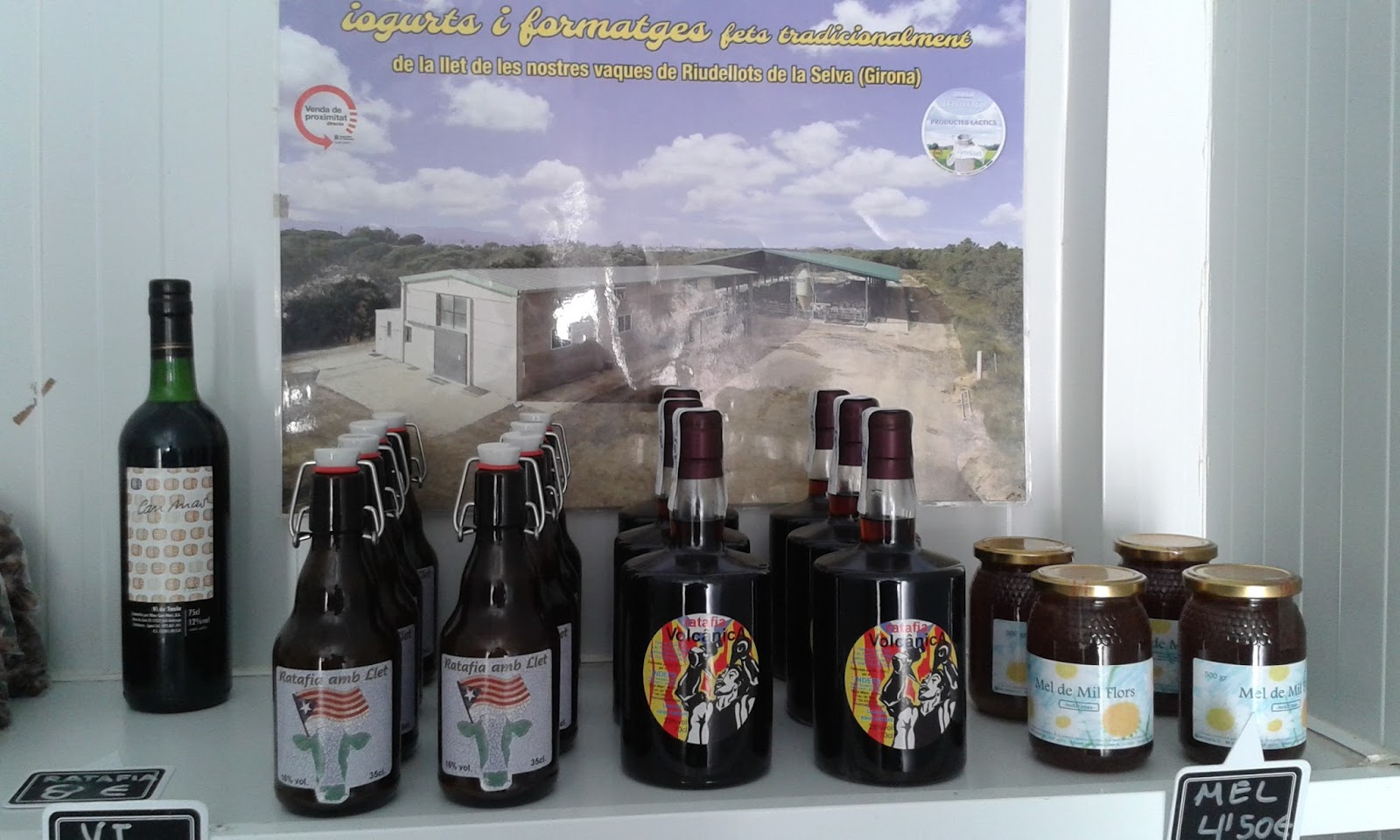
Nova agrobotiga Ratafia amb Llet SANT GALDRIC a la comarca de la Selva GRANJA EL PROVENÇAL
Des d'ara també podeu trobar la Ratafia amb Llet a l'agrobotiga de la granja EL PROVENÇAL de Riudellots de la Selva
GRANJA EL PROVENÇAL
Ctra N-156, 485, Mas Fàbregas
17457 Riudellots de la Selva, Girona
Telèfon:972 47 74 23
www.granjaelprovensal.cat
GRANJA EL PROVENÇAL
Ctra N-156, 485, Mas Fàbregas
17457 Riudellots de la Selva, Girona
Telèfon:972 47 74 23
www.granjaelprovensal.cat
diumenge, 13 de desembre del 2015
Aquestes festes regla Ratafia amb Llet. Per Nadal i Reis fes un SANT GALDRIC! i per Cap d'Any fes LA GROSSA!
Establiments recomants per Ratafia amb Llet SANT GALDRIC
VINS BUSTINS Ctra de Vilavenut, s/núm Tel 972580280 - 17820 Banyoles
AGROBOTIGA LA CLOTXA Barcelona, 17 Tel 938794936 - 08401 Granollers
CARNISSERIA CONSOL Mercat de Salt Tel 972235716 - 17190 Salt
CAN COSTABELLA Sant Andreu, 46 Tel 972570540 - 17846 Mata
BAR RESTAURANT EL FORN CASAL INDEP Plaça Sant Pere, 5 Tel 972981607 - 17007 Girona
SUPERMERCAT FORNELLS OLIVETS Carretera de Santa Coloma, s/núm Tel 972238017 - 17181 Aiguaviva
CAFÈ DE LA SELIS Pompeu Fabra, 17 Tel 972851360 - 17411 Vidreres
RESTAURANT CA L'ENRIC Ctra de Camprodon N-260, km 91 Tel 972290015 - 17813 Vall de Bianya
RESTAURANT LES COLS Carretera la Canya, s/núm. Tel 972269209 - 17800 Olot
AGROBOTIGA EL FORN Ctra de Sta Coloma, km 13 Tel 972474683 - 17185 Vilobí d'Onyar
VINS PARÉS Avgda Ildefons Cerdà, 119 Tel 938810060 - 08540 Centelles
AGROBOTIGA MAS BES Bústia, 3 Mas Bes Tel 660290678 - 17184 Salitja
GRANJA EL PROVENÇAL N-156, 485 Mas Fàbregas Tel 972477423 - 17457 Riudellots de la Selva
Demana també les teves participacions de la loteria de Cap d'Any amb els números de 17181 AIGUAVIVA, 17183 SANT DALMAI, 17184 SALITJA i 17185 VILOBÍ D'ONYAR
I SI NO TOCA, QUE HI HAGI PER TOTHOM SALUT I FORÇA AL CANUT!
CB on the Road: Santa Coloma de Farners' Ratafia Festival
2015 has been a banner year for the herb-infused liqueur known as ratafia. In the little town of Santa Coloma de Farners, within the Catalan province of Girona, locals have been making this unique libation for centuries, with each family passing down their own version of the drink from one generation to the next. In 1997, within the county’s official records, came a major food discovery –written recipes for three distinct styles of ratafia dating back to 1842, which are now recognized as the oldest of their kind in Catalonia. These handwritten lists of ingredients (along with other culinary notations, savory recipes and home remedies) were discovered in the old notebooks of Francesc Rosquellas, once the proprietor of a cafe/restaurant in Santa Coloma de Farners whose name had long since been forgotten.
Upon discovering these precious bits of gastronomic patrimony, the Ajuntament (City Hall) of Santa Coloma de Farners charged the local distiller Russet with the task of recreating these historic concoctions, beginning straight off in 1997 with the “Clàssica 1842.” Russet proceeded to release the “La Nou Verda” recipe in 2002 and the “Vuit Porrons” in 2014. Since 1997, the town of Santa Coloma de Farners – and the world of ratafia at large – has considered these three recipes its defining doctrine. Naturally, it was with giddy excitement that a new, fourth Rosquellas recipe was discovered in 2015 within the same town records as before, a recipe with tart cherry as its base ingredient.
In honor of this stirring addition to ratafia’s historical lineage, Russet now sells a four-bottle box set – an essential for the after-dinner arsenal of any ratafia aficionado and the star of 2015’s much-anticipated Fira de Ratafia of Santa Coloma de Farners, the 34th annual festival honoring this dark and complex digestif.
The celebration (in the form of a ratafia-making competition) technically began in 1982, though the first two years of celebration were actually bundled in with Santa Coloma de Farners’ Festa Major (the biggest annual town celebration, held each year on September 24). In 1984, ratafia finally earned its own moment in the sun, and the festival moved to the second weekend of November each year.
Some of the ingredients that go into making ratafia at the Ratafia Festival, photo by Sam Zucker
The process of making ratafia is tied tightly to the seasons. In mid June, as the wild herbs in the surrounding countryside reach their full, aromatic glory, local vendors pluck them from field and farm and sell them in fragrant bundles in the streets of Santa Coloma de Farners. Bulbous glass flasks are filled with potent aguardent on terraces throughout town, in preparation for Saint John’s Eve (La Vispera de Sant Joan), perhaps better known as the Summer Solstice. On this “magical” night, fists full of green walnuts (nou verda), spices, herbs and much more are added to 120-proof neutral grape brandy and set to macerate.
“Without the nou verda you can’t call it ratafia,” explained Mireia Vial as she passed around a wooden box full of little plastic bags packed with the four dozen or so most typical ratafia ingredients used in Santa Coloma de Farners. Vial is an Official Guide of Catalunya and grew up not far from Santa Coloma de Farners in the Gironese region of La Empordà. The box she passed to us is emblazoned with the logo of the Confraria de la Ratafia – the Ratafia Brotherhood. The Confraria is the official governing force in Santa Coloma de Farners when it comes to ratafia and their symbol is a half moon and half sun, representing sol i serena – an essential part of the ratafia making process that refers to the period in which sun and shade fall over the glass flasks in which ratafia is aged as they sit on local outdoor terraces throughout July and August. Though this tradition and technique is mostly learned from within one’s family, the Town Hall and the Confraria organize public workshops throughout the year to guide novices in each step of the process.
When making ratafia, the first (and most important) elements to add are green walnuts, followed by the other botanicals of your choosing. Once mixed, the concoction is left at the mercy of the elements, infusing, oxidizing, and intensifying in flavor for 40 days. “In Santa Coloma de Farners, we swirl the liquid in the flask periodically while it macerates,” explains Mireia. “This is a unique practice that gives the ratafia a more intense flavor.” After the first 40 days, the liquid is filtered into smaller glass bottles (or oak barrels in some cases) and aged further, allowing the powerful punch of the alcohol itself to mellow out as the delicate, intricate, herbal matrices of the liqueur shines through. After another few months of anxious waiting, the ratafia is filtered again and is finally ready to drink at the beginning of November, a boozy catharsis that coincides each year with the Fira de Ratafia.
Santa Coloma de Farners' Ratafia Festival, photo by Sam Zucker
The Ratafia Festival is much more than just a showcase of local producers and ratafia-laced treats (which run the gamut from pastries and sausages to teas and ice creams). Throughout the four main days of the festival, and for some days before as well, a multitude of events and activities are offered to the public, including distillation demos, ratafia making workshops, guided tastings, cooking classes, live musical concerts, historic walking tours and photography lectures.
One of the biggest events of the week is the Ratafia Making Competition, dating all the way back to 1982 and still going strong; in 2015, 212 ratafias were entered. Judges, including the famous Catalan chef Joan Roca of Celler de Can Roca, evaluated each homemade infusion for color, aroma and flavor. The winner’s name was immortalized on the “Olympus of Ratafia” – a trophy displayed in the upstairs hall of local establishment Can Trias and the principal exhibit of the L’Univers de la Ratafia. Consisting of an itinerary of emblematic places in Santa Coloma de Farners related to the world of ratafia, “The Universe of Ratafia” begins at Can Trias, where there is a wealth of information on display. In addition, plaques and QR codes at points of interest throughout the town offer visitors the full ratafia story in a very visual, interactive way.
Keeping in the spirit of the festivities, during the Fira de Ratafia, nearly all of the restaurants in Santa Coloma de Farners offer a special “Ratafia Menu.” The beauty of using ratafia in the kitchen is that this herbal liqueur is equally adaptable to sweet and savory dishes. As every ratafia is different, one must analyze each mixture’s predominant notes and use them as a guideline in the pairing, as is done with expert precision at legendary pastry shop Casa Tuyarro.
Drinking ratafia from a porron at Casa Tuyarro, photo by Sam Zucker
Pastisseria Casa Tuyarro was founded in 1894 and sits just off of the Plaça de Farners. Besides being one of the oldest and most beautiful “early modernist” shops in town offering a vast array of ratafia brands and ratafia-infused pastries, Casa Tuyarro also makes its own ratafia. While some styles we tasted during the fira had bold notes of licorice, thyme and rosemary, that of Casa Tuyarro had an unmistakable, predominant flavor: cumin. A bit odd, the combination of sweet alcohol and pungent cumin seeds, poured in long streams from classic Catalan porrons, was actually quite enjoyable. As we contemplated the savory culinary preparation in which this particular ratafia would feel at home, we were presented with a sampling of this classic pastisseria’s most popular confections. Each cake and cookie was bursting with sweet, herbal goodness, including the Tortell de Ratafia, a round, walnut-studded cake that is the house specialty.
When passing the day in Santa Coloma de Farners during the Fira de Ratafia, it is easy to get carried away with the free samples and find yourself in a half-drunken state, with a sugar-infused hangover looming on the horizon. Our recommendation is to take it slow and fortify yourrself with a hearty menu de ratafia at the restaurant Vent d’Aram, located in a lovely modernist building just one block from Casa Tuyarro. This year, in honor of the festival, the Vent d’Aram was offering a €25 set menu that included canelons of roast duck with ratafia and foie gras, bacallà (salt cod) with cream of ratafia, confited pork cheek with prunes, chestnuts and ratafia and ratafia tiramisú for a sweet finish. After a leisurely meal, another stroll around the small town center, taking in the sights, sounds and smells of Santa Coloma de Farners in its moment of festive glory, is definitely in order.
Visit the event website for more information about the Fira de Ratafia in Santa Coloma de Farners.
CULINARY BACKSTREETS
Upon discovering these precious bits of gastronomic patrimony, the Ajuntament (City Hall) of Santa Coloma de Farners charged the local distiller Russet with the task of recreating these historic concoctions, beginning straight off in 1997 with the “Clàssica 1842.” Russet proceeded to release the “La Nou Verda” recipe in 2002 and the “Vuit Porrons” in 2014. Since 1997, the town of Santa Coloma de Farners – and the world of ratafia at large – has considered these three recipes its defining doctrine. Naturally, it was with giddy excitement that a new, fourth Rosquellas recipe was discovered in 2015 within the same town records as before, a recipe with tart cherry as its base ingredient.
In honor of this stirring addition to ratafia’s historical lineage, Russet now sells a four-bottle box set – an essential for the after-dinner arsenal of any ratafia aficionado and the star of 2015’s much-anticipated Fira de Ratafia of Santa Coloma de Farners, the 34th annual festival honoring this dark and complex digestif.
The celebration (in the form of a ratafia-making competition) technically began in 1982, though the first two years of celebration were actually bundled in with Santa Coloma de Farners’ Festa Major (the biggest annual town celebration, held each year on September 24). In 1984, ratafia finally earned its own moment in the sun, and the festival moved to the second weekend of November each year.
Some of the ingredients that go into making ratafia at the Ratafia Festival, photo by Sam Zucker
The process of making ratafia is tied tightly to the seasons. In mid June, as the wild herbs in the surrounding countryside reach their full, aromatic glory, local vendors pluck them from field and farm and sell them in fragrant bundles in the streets of Santa Coloma de Farners. Bulbous glass flasks are filled with potent aguardent on terraces throughout town, in preparation for Saint John’s Eve (La Vispera de Sant Joan), perhaps better known as the Summer Solstice. On this “magical” night, fists full of green walnuts (nou verda), spices, herbs and much more are added to 120-proof neutral grape brandy and set to macerate.
“Without the nou verda you can’t call it ratafia,” explained Mireia Vial as she passed around a wooden box full of little plastic bags packed with the four dozen or so most typical ratafia ingredients used in Santa Coloma de Farners. Vial is an Official Guide of Catalunya and grew up not far from Santa Coloma de Farners in the Gironese region of La Empordà. The box she passed to us is emblazoned with the logo of the Confraria de la Ratafia – the Ratafia Brotherhood. The Confraria is the official governing force in Santa Coloma de Farners when it comes to ratafia and their symbol is a half moon and half sun, representing sol i serena – an essential part of the ratafia making process that refers to the period in which sun and shade fall over the glass flasks in which ratafia is aged as they sit on local outdoor terraces throughout July and August. Though this tradition and technique is mostly learned from within one’s family, the Town Hall and the Confraria organize public workshops throughout the year to guide novices in each step of the process.
When making ratafia, the first (and most important) elements to add are green walnuts, followed by the other botanicals of your choosing. Once mixed, the concoction is left at the mercy of the elements, infusing, oxidizing, and intensifying in flavor for 40 days. “In Santa Coloma de Farners, we swirl the liquid in the flask periodically while it macerates,” explains Mireia. “This is a unique practice that gives the ratafia a more intense flavor.” After the first 40 days, the liquid is filtered into smaller glass bottles (or oak barrels in some cases) and aged further, allowing the powerful punch of the alcohol itself to mellow out as the delicate, intricate, herbal matrices of the liqueur shines through. After another few months of anxious waiting, the ratafia is filtered again and is finally ready to drink at the beginning of November, a boozy catharsis that coincides each year with the Fira de Ratafia.
Santa Coloma de Farners' Ratafia Festival, photo by Sam Zucker
The Ratafia Festival is much more than just a showcase of local producers and ratafia-laced treats (which run the gamut from pastries and sausages to teas and ice creams). Throughout the four main days of the festival, and for some days before as well, a multitude of events and activities are offered to the public, including distillation demos, ratafia making workshops, guided tastings, cooking classes, live musical concerts, historic walking tours and photography lectures.
One of the biggest events of the week is the Ratafia Making Competition, dating all the way back to 1982 and still going strong; in 2015, 212 ratafias were entered. Judges, including the famous Catalan chef Joan Roca of Celler de Can Roca, evaluated each homemade infusion for color, aroma and flavor. The winner’s name was immortalized on the “Olympus of Ratafia” – a trophy displayed in the upstairs hall of local establishment Can Trias and the principal exhibit of the L’Univers de la Ratafia. Consisting of an itinerary of emblematic places in Santa Coloma de Farners related to the world of ratafia, “The Universe of Ratafia” begins at Can Trias, where there is a wealth of information on display. In addition, plaques and QR codes at points of interest throughout the town offer visitors the full ratafia story in a very visual, interactive way.
Keeping in the spirit of the festivities, during the Fira de Ratafia, nearly all of the restaurants in Santa Coloma de Farners offer a special “Ratafia Menu.” The beauty of using ratafia in the kitchen is that this herbal liqueur is equally adaptable to sweet and savory dishes. As every ratafia is different, one must analyze each mixture’s predominant notes and use them as a guideline in the pairing, as is done with expert precision at legendary pastry shop Casa Tuyarro.
Drinking ratafia from a porron at Casa Tuyarro, photo by Sam Zucker
Pastisseria Casa Tuyarro was founded in 1894 and sits just off of the Plaça de Farners. Besides being one of the oldest and most beautiful “early modernist” shops in town offering a vast array of ratafia brands and ratafia-infused pastries, Casa Tuyarro also makes its own ratafia. While some styles we tasted during the fira had bold notes of licorice, thyme and rosemary, that of Casa Tuyarro had an unmistakable, predominant flavor: cumin. A bit odd, the combination of sweet alcohol and pungent cumin seeds, poured in long streams from classic Catalan porrons, was actually quite enjoyable. As we contemplated the savory culinary preparation in which this particular ratafia would feel at home, we were presented with a sampling of this classic pastisseria’s most popular confections. Each cake and cookie was bursting with sweet, herbal goodness, including the Tortell de Ratafia, a round, walnut-studded cake that is the house specialty.
When passing the day in Santa Coloma de Farners during the Fira de Ratafia, it is easy to get carried away with the free samples and find yourself in a half-drunken state, with a sugar-infused hangover looming on the horizon. Our recommendation is to take it slow and fortify yourrself with a hearty menu de ratafia at the restaurant Vent d’Aram, located in a lovely modernist building just one block from Casa Tuyarro. This year, in honor of the festival, the Vent d’Aram was offering a €25 set menu that included canelons of roast duck with ratafia and foie gras, bacallà (salt cod) with cream of ratafia, confited pork cheek with prunes, chestnuts and ratafia and ratafia tiramisú for a sweet finish. After a leisurely meal, another stroll around the small town center, taking in the sights, sounds and smells of Santa Coloma de Farners in its moment of festive glory, is definitely in order.
Visit the event website for more information about the Fira de Ratafia in Santa Coloma de Farners.
CULINARY BACKSTREETS
dissabte, 5 de desembre del 2015
VI FESTA DE LA RATAFIA DE BERGA Dissabte 12 de desembre del 2015
VI Festa de la Ratafia a Berga de la mà del Casal Panxo! Concurs, tast, sopar i molt més dissabte que ve.
61es Jornades Gastronòmiques DESEMBRE 2015
JORNADA DEL PORC
Data: 7 de desembre del 2015
Lloc: Cau del Nap
Degustacions:
PATATES DE RIUDELLOTS DE LA SELVA
EMBOTIS DE SALT
XUIES DE SALT
BOTIFARRES PICANTS DE SALT
BOLETS DE SALITJA
VI DE VILOBÍ D'ONYAR
AIGUA DE SANT ANIOL
BOMBONS D'UCRAÏNA
RATAFIA DE SALITJA
LICOR DE CASSÍS DE LA VALL D'ARAN
Embotits de ca la Consol del Mercat de Salt
Pinetells de sota el pi de can Saus a la vinagreta
Patates rosses de Riudellots extra-cruixents
Xuies a la brasa de ca la Consol
Botifarres picants de ca la Consol
Vi de can Juli de Vilobí
Aigua volcànica de Sant Aniol
Bombons d'Ucraïna
Ratafia Volcànica Prèmium
Ratafia amb Llet de la Vall d'Onyar
Licor de cassís Dera Val d'Aran
Data: 7 de desembre del 2015
Lloc: Cau del Nap
Degustacions:
PATATES DE RIUDELLOTS DE LA SELVA
EMBOTIS DE SALT
XUIES DE SALT
BOTIFARRES PICANTS DE SALT
BOLETS DE SALITJA
VI DE VILOBÍ D'ONYAR
AIGUA DE SANT ANIOL
BOMBONS D'UCRAÏNA
RATAFIA DE SALITJA
LICOR DE CASSÍS DE LA VALL D'ARAN
Embotits de ca la Consol del Mercat de Salt
Pinetells de sota el pi de can Saus a la vinagreta
Patates rosses de Riudellots extra-cruixents
Xuies a la brasa de ca la Consol
Botifarres picants de ca la Consol
Vi de can Juli de Vilobí
Aigua volcànica de Sant Aniol
Bombons d'Ucraïna
Ratafia Volcànica Prèmium
Ratafia amb Llet de la Vall d'Onyar
Licor de cassís Dera Val d'Aran
Subscriure's a:
Missatges (Atom)